This a book being used in some international schools in Cambodia. For instance, it is currently included in the curriculum of Western International School for students in grade 10th. In order to help those students reach both theoritical and practical learinging of physics, we have tried hard to find solution manual of the book. Please be noted that this document is not used for cheating during the class, or any kind of tasks being tested while there is no allowance to take other documents beside class textbook. It is rather used for self-study, or home tutoring. Please click here to download the document from our Dropbox; moreover, you may click here to reach the original website. Disclaimer: We do not own this document; we just want to share all kinds of educational sources, especially ones free of charge.
A synchrotron is a large
machine (about the size of a football field) that accelerates electrons to
almost the speed of light. As the electrons are deflected through magnetic
fields they create extremely bright light.
The light
is channelled down beamlines to experimental workstations where it is used for
research.
Illustration of the
Australian Synchrotron
Synchrotron applications
Synchrotron light is
advancing research and development in fields as diverse as:
·biosciences (macromolecular/protein crystallography and
cell biology)
·medical research (microbiology, disease mechanisms,
high resolution imaging and cancer radiation therapy)
·environmental sciences (toxicology, atmospheric
research, clean combustion and cleaner industrial production technologies)
·agriculture (plant genomics, soil studies, animal and
plant imaging)
·minerals exploration (rapid analysis of drill core
samples, comprehensive characterisation of ores for ease of mineral processing)
·advanced materials (nanostructured materials,
intelligent polymers, ceramics, light metals and alloys, electronic and
magnetic materials)
·engineering (imaging of industrial processes in real
time, high resolution imaging of cracks and defects in structures, the
operation of catalysts in large chemical engineering processes)
·forensics (identification of suspects from extremely
small and dilute samples).
What is synchrotron light?
Synchrotron light is the electromagnetic
radiation emitted when electrons, moving at velocities close to the speed
of light, are forced to change direction under the action of a magnetic field.
The electromagnetic radiation is emitted
in a narrow cone in the forward direction, at a tangent to the electron's
orbit.
Synchrotron light is unique in its
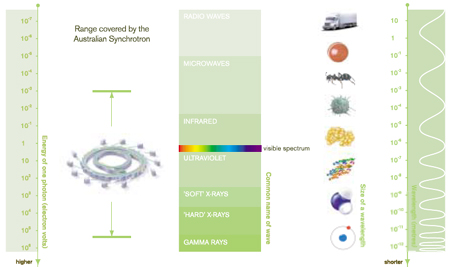
intensity and brilliance and it can be generated across the range of the
electromagnetic spectrum: from infrared to
x-rays.
The electromagnetic spectrum, showing the range of the Australian
Synchrotron
Properties of synchrotron light
Synchrotron light has a number of unique
properties. These include:
·High
brightness: synchrotron light is
extremely intense (hundreds of thousands of times more intense than that from
conventional x-ray tubes) and highly collimated.
·Wide
energy spectrum: synchrotron light is emitted
with energies ranging from infrared light to hard x-rays.
·Tunable: it is possible to obtain an intense
beam of any selected wavelength.
·Highly
polarised: the synchrotron emits highly polarised
radiation, which can be linear, circular or elliptical.
·Emitted
in very short pulses: pulses emitted
are typically less than a nano-second (a billionth of a second), enabling
time-resolved studies.
How synchrotron light is created?
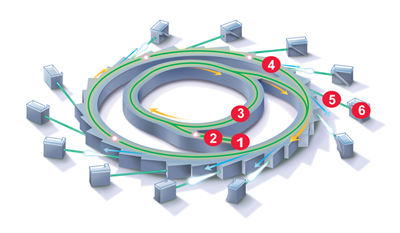
1.electron gun
2.linear accelerator (linac)
3.booster ring
4.storage ring
5.beamline
6.end station
Electrons are generated in the centre
(electron gun) and accelerated to 99.9997% of the speed of light by
the linear accelerator (linac). The electrons are then transferred to the
booster ring, where they are increased in energy. They are then
transferred to the outer storage ring.
The electrons are circulated around
the storage ring by a series of magnets separated by straight sections. As
the electrons are deflected through the magnetic field created by the magnets,
they give off electromagnetic radiation, so that at each bending magnet a beam
of synchrotron light is produced.
Illustration
of a bending magnet.
At each deflection of the
electron path a beam of light
is produced. The effect is similar to the
sweeping of a search light. These
beams can be captured and focussed to a specific wavelength appropriate for a
particular technique.
Insertion Devices
It was found that the intensity of light can be significantly increased by the
use of 'insertion devices' in the straight sections of the ring.
There are two classes of insertion devices. One is
a multipole wiggler (MPW)in which a cone of light is emitted at each bend in the 'wiggle' so that
the cones of light superimpose on each other, the intensity increasing with the
number of bends.
Illustration
of a multipole wiggler. At the peak of each wave, a beam of
light is emitted. These beams reinforce each other and appear as a broad beam
of incoherent synchrotron light when viewed in the horizontal plane
ahead of the wiggler.
The second type of device is an undulator. It uses less powerful magnets to
produce gentler undulations of the beam. In this case, the light cones just
overlap and interfere with each other, so that certain wavelengths of light are
enhanced perhaps by 10,000 times. These wavelengths can be changed by altering
the gap between the component magnets so that the light is tunable to specific
wavelengths.
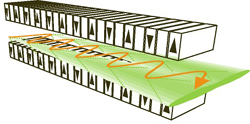
Illustration
of an undulator.
The poles produce less deflection of the
electron beam. This results in a narrow beam of coherent synchrotron light, with certain frequencies amplified by up to 10,000 times.
Current ('third generation') designs of
synchrotrons aim to optimise the intensity that can be obtained from insertion
devices. In particular, attention is given to the size and positioning of the straight
sections that accommodate the insertion devices.
The Australian Synchrotron is an
advanced 'third generation' design. It uses the three different
types of light sources (bending
magnets, multipole wigglers and undulators) to enable a wide range of advanced experiments or measurements to be
carried out.